About Darkwind
Darkwind
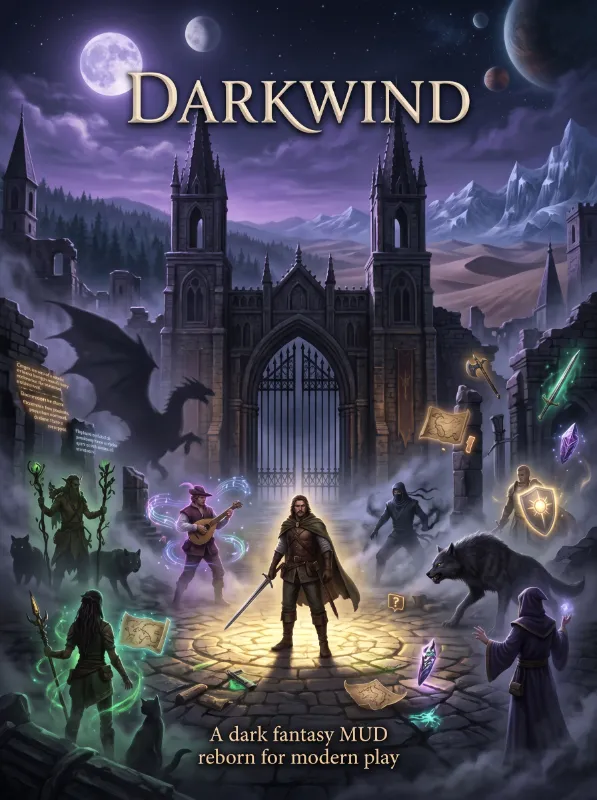
Darkwind is a long-running dark fantasy MUD with decades of history, a huge world to explore, and an active modern development cycle. It keeps the depth and mystery of classic text-based adventuring while adding modern conveniences like GMCP, sound, room art, a polished browser client, and accessibility features for screenreader users.
What Makes Darkwind Different
Darkwind is not a tiny nostalgia project or a bare-bones hack-and-slash. It is a large, evolving fantasy world with deep character systems, many active guilds, dangerous areas, player progression loops, crafting, unique loot, bosses, quests, and long-term goals.
You can play through a modern web client at play.darkwind.ai, or connect with a traditional MUD client.
Guilds With Real Identity
Darkwind’s guilds are not just class labels. Each guild has its own commands, mechanics, resources, style, and progression.
Active guilds include:
- Bards, with songs, harmonies, instruments, performance, archetypes, and musical combat flow.
- Druids, with nyfwre resources, rituals, companions, skyblades, vines, groves, and nature-based invocations.
- Rangers, with wilderness tools, terrain identity, enemy types, traps, poultices, teas, salves, and survival abilities.
- Ninjas, with marks, stealth, bare-handed combat, special techniques, and assassination-style progression.
- Monks, with chi, disciplined combat, and aura support.
- Paladins, with divine shields, javelin charge, holy powers, and Mitran faith.
- Priests of Set, with darker divine themes and evil-aligned powers.
- Garou, with shapeshifting, packs, claws, klaives, and bestial combat identity.
- Dragons, with age-based growth, lairs, dragon forms, breath, treasure handling, and mythic power.
- Thieves, Mages, Fighters, Necromancers, Swashbucklers, and others, each with their own systems and flavor.
Many guilds have mechanics that go beyond simple “cast spell, wait for cooldown.” They have bars, resources, forms, companions, special gear, rituals, marks, songs, stances, or other systems that shape how they play.
A Huge World To Explore
Darkwind spans multiple regions, continents, and even planets. You will find cities, forests, deserts, temples, caves, ruins, dungeons, islands, underworld zones, astral areas, and strange faraway places.
The world includes:
- Darkwind City, the central hub and starting point for many adventurers.
- Souvrael, with deserts, mines, temples, and dangerous wilderness.
- Kerei, with eastern-inspired areas, roads, temples, martial threats, and hidden dangers.
- Hyperborea, with frozen lands, cursed forests, and northern threats.
- Talamh Darag, with ancient and mystical regions.
- Volcano Island, Underworld, and other dangerous realms.
- Other planets and moons with their own identities and area catalogs.
The game includes wayshard travel and an area catalog system, but exploration still matters. Finding places, learning routes, discovering secrets, and understanding where to hunt are all part of the experience.
Quests, Dailies, And Long-Term Goals
Darkwind has a modernized quest system with many types of objectives. You can take on story quests, daily tasks, guild quests, deity quests, lore quests, delivery quests, kill quests, and chains of connected objectives.
Quests are designed to give more structure to exploration without turning the game into a theme park. They help point players toward content, reward activity, and give more reasons to revisit parts of the world.
There are also daily rewards, achievements, reputation effects, and systems that encourage regular play without forcing a single narrow path.
Unique Loot And Bosses
Darkwind has a strong unique item culture. Players can hunt for rare and powerful weapons, armor, auras, shoulder pieces, rings, artifacts, and other special equipment.
The game tracks unique items and whether they have been claimed during the current reboot. This gives players a reason to hunt, explore, and compete for rare finds without always exposing who has what.
Bosses have tiers, phases, special mechanics, and custom loot. Some encounters are straightforward fights, while others involve more elaborate area or objective design.
Professions And Crafting
Darkwind’s professions system gives players more to do than fight. Professions support gathering, crafting, reagents, work orders, inlays, polishing, oiling, quality grades, and profession-specific materials.
You can gather reagents, craft equipment, enhance items, fulfill work orders, and create gear with meaningful details. Crafted items can have quality, materials, inlays, and custom properties. The system continues to expand toward making professions more useful, popular, and connected to the rest of the game.
Eternal Dungeons
Eternal Dungeons are repeatable, scaling dungeon runs with special objectives, bosses, relics, shrines, portals, and leaderboard-style progression.
They are designed as a long-term replayable activity for players who want a structured challenge outside normal area hunting. The system continues to evolve with new objective types and better dungeon flow.
Reputation, Events, And World Feedback
Darkwind has reputation and renown-style systems that react to player actions. The game does not always expose every formula, but it gives players a sense that their actions matter.
There are event channels, death messages, invasion systems, reputation changes, unique item announcements, and other world feedback loops that make the game feel alive.
Modern Web Client
Darkwind can be played through Darkflow, the custom browser client at play.darkwind.ai.
Darkflow supports:
- GMCP-driven panes.
- Health, spell point, weight, guild vitals, enemy status, and other live UI panels.
- Room images and generated object images.
- Sound effects and ambient audio.
- Channel panes and notifications.
- Trigger, alias, timer, and automation systems.
- Regex support for triggers and aliases.
- ANSI colors, truecolor, and text effects.
- Shared YouTube video panes.
- Screenreader accessibility improvements.
- Responsive terminal width negotiation.
- A modern interface without losing traditional MUD compatibility.
You can still use a traditional MUD client if you prefer.
Accessibility Matters
Darkwind has received dedicated accessibility work for visually impaired players and screenreader users.
Screenreader mode changes how room descriptions, movement, channels, inventory, and combat output are presented. Channel messages become more natural to hear, combat can be summarized, noisy environmental chatter can be reduced, and new players can identify themselves as screenreader users during creation.
The goal is not just “technically usable,” but actually more comfortable to play.
Sound, Images, And Atmosphere
Darkwind is still a text MUD, but it uses modern sensory layers where appropriate.
The web client can play sounds for combat, bard instruments, ambient events, corpse burners, hourly echoes, and other systems. Room and object image generation helps give visual players a stronger sense of place without replacing written descriptions.
This gives the game a hybrid feel: classic text depth with modern atmosphere.
Player Freedom
Darkwind supports many ways to play:
- Hunt monsters.
- Chase uniques.
- Complete quests.
- Join and master guilds.
- Craft and gather.
- Explore hidden areas.
- Build reputation.
- Run Eternal Dungeons.
- Collect rare equipment.
- Participate in events.
- Play socially through channels.
- Experiment with unusual guild combinations.
- Build toward long-term power.
It is a game for players who enjoy discovery, systems, and character identity.
Active Development
Darkwind is actively developed and updated. New guild mechanics, quality-of-life improvements, accessibility features, areas, quests, client improvements, balance passes, and system rewrites are added regularly.
The game has the depth of an older MUD, but it is not frozen in time. Systems are being modernized, rough edges are being cleaned up, and player feedback regularly turns into real updates.
Why Try Darkwind?
Try Darkwind if you want a MUD with:
- A large dark fantasy world.
- Many distinct guilds with real mechanics.
- Long-term progression and rare loot.
- Crafting, professions, quests, and exploration.
- A modern browser client with GMCP, sound, images, and automation.
- Active development.
- Strong accessibility attention.
- Classic MUD mystery with modern polish.
Darkwind is built for players who like learning a world, mastering systems, finding secrets, and growing a character over time.
Key Features
- dark fantasy world
- active development
- modern web client
- traditional telnet access
- GMCP support
- sound effects
- ambient audio
- room images
- generated object images
- screenreader accessibility
- custom screenreader mode
- channel notifications
- Discord integration
- quests
- daily quests
- quest chains
- achievements
- reputation system
- renown tracking
- event announcements
- invasions
- boss encounters
- tiered bosses
- phased bosses
- unique loot
- unique item tracking
- professions
- crafting
- gathering
- reagents
- work orders
- inlays
- polishing
- weapon oiling
- item quality grades
- player housing
- homesteads
- wayshard travel
- area catalog
- waypoints
- Eternal Dungeons
- dungeon objectives
- dungeon leaderboards
- guilds
- multi-guilding
- guild resources
- guild vitals
- companions
- summons
- rituals
- songs
- harmonies
- bard instruments
- druid groves
- ranger terrain systems
- ninja marks
- dragon lairs
- Garou packs
- monk chi
- paladin javelin charge
- thief skills
- mage spells
- necromancy
- clans
- player channels
- newbie support
- truecolor support
- ANSI text effects
- aliases
- triggers
- timers
- automation scripts
- regex triggers
- regex aliases
- responsive terminal width
- inventory polish
- equipment slots
- auras
- shoulders
- second ring slot
- second neck slot
- player deaths on Events
- lottery
- daily rewards
- help system
- newbie tome
- web-based play
- classic MUD exploration
How to Connect
darkwind.ai
4242
telnet darkwind.ai 4242Stats
20
Players
5.0 / 5.0
2 reviews
0
Votes this month
22
Total votes
1992
Established
Game Details
fantasy
lpmud
Active