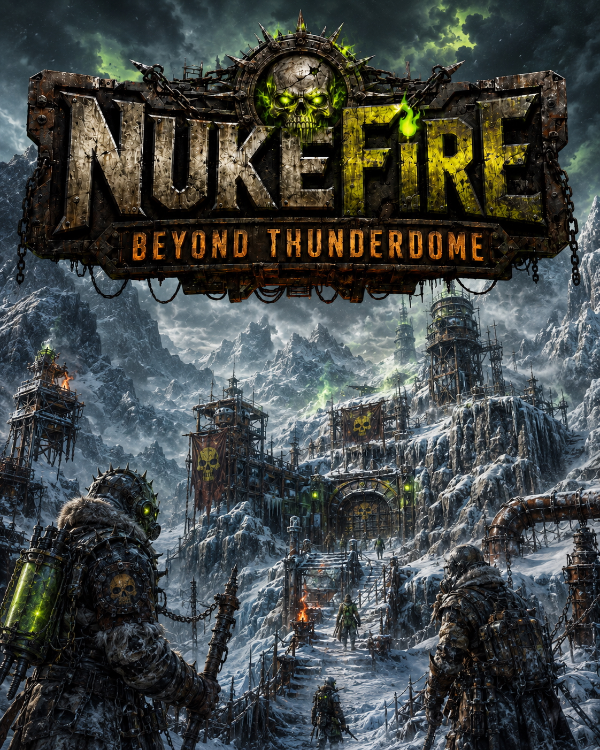
About NukeFire
Welcome to TDome NukeFire — Beyond Thunderdome
Download the OFFICIAL NukeFire Client here: https://www.nukefire.org/client
NukeFire is a vast, living MUD descended from the original Thunderdome of Missoula, Montana.
It preserves the old-school foundations that made MUDs worth inhabiting: dangerous exploration, earned knowledge, permanent characters, deep equipment, cooperation, secrets, and a world with enough history to reward those who pay attention.
At the same time, NukeFire has grown far beyond the game from which it began.
More than 40,000 rooms, hundreds of zones, extensive remort progression, server-side navigation, built-in automation, screen-reader augmentation, procedural adventures, advanced equipment systems, and years of continuous development have turned it into something that must be experienced rather than summarized.
NukeFire is not built to be finished in a weekend.
It is built to become a place you know.
A Community That Notices When You Arrive
New players do not quietly disappear into an empty starting room.
The game announces new arrivals to the community, and experienced players are usually quick to offer directions, equipment, answers, and help with the early game.
That welcoming culture has developed through years of daily interaction between players, builders, and administrators. Player reports have led directly to new commands, accessibility tools, class abilities, equipment systems, zone repairs, interface improvements, and entirely new forms of progression.
The people playing NukeFire are not merely passing through a static game.
They are helping shape a world that is still being built.
Remort, Rebuild, and Become Something Greater
Remorting is the heart of NukeFire progression.
A character reaches the height of one life, returns to the beginning, and carries permanent growth into the next. Each remort can add health, mana, movement, damage, accuracy, defense, regeneration, resistances, and other lasting improvements.
Remorting also opens new class combinations, class-remort abilities, specialized progression tracks, Class Legacy runes, and advanced paths such as Headhunters, Voidstrikers, Curists, and many others.
A remort is not a discarded character.
It is another layer added to the same history.
The road extends through hundreds of remorts, with long-term progression continuing as far as you dare go. Major milestones may unlock new skills, unique rewards, specialized systems, or legendary equipment created to mark the achievement.
A MUD With Its Own Client Built Into the World
Many MUDs expect players to assemble their own mapper, triggers, aliases, pathfinder, timers, scripts, and accessibility package before the game begins to feel manageable.
NukeFire has steadily brought those tools inside the game itself.
The result is a command-driven MUD that increasingly feels like it has its own client, regardless of which outside program a player chooses to connect with.
BIGMAP
The built-in BIGMAP provides immediate local awareness after movement.
It centers on the player, displays reachable rooms, recognizes doors and one-way passages, indicates visible vertical exits, and can overlay an active GPS route directly onto the map.
The route is visible. The destination is marked. The player can see how the surrounding rooms connect without maintaining a separate client-side mapper.
BIGMAP also includes memory and legend controls, allowing players to decide how explored space and map symbols are presented.
Saved and Recorded Paths
NukeFire includes its own path system for journeys that players expect to travel again.
Routes can be recorded while walking, saved under a useful name, reviewed, followed one step at a time, or run automatically. This is more than a string of directions pasted into a client.
The game understands the route.
Travel tools can work with movement rules, saved destinations, interruptions, group travel, and safety conditions. Players can keep personal routes to shops, hunting grounds, services, remote zones, or any landmark worth remembering.
The world becomes easier to navigate because the character has learned it, not because the player installed someone else's script package.
Server-Side Actions and Aliases
The ACTION system provides game-side reactions to text seen by the character.
A player can save a pattern and have the game queue one or more ordinary commands when that pattern appears. Actions can assist with healing, fortification, fleeing, recalls, group support, and other repeatable situations.
Because the system runs on the server, the setup follows the character rather than being trapped inside one client installation.
Aliases provide the same continuity for command shorthand, while tools such as action debugging and queue inspection help players understand what is matching, what is waiting, and why something did or did not fire.
FLUSHQUEUE provides an emergency way to clear pending commands when the situation changes.
Group Command and Battleorder Support
Coordinated groups can use BATTLEORDER and related command tools to issue organized instructions without depending entirely on outside macros.
Approved crews can establish ordered actions, respond to urgent commands, and coordinate complicated fights through systems understood by the game itself.
These tools do not replace player judgment.
They help players carry out that judgment when a battle becomes too fast and complicated for repeated manual command entry.
GPS That Does More Than Point North
NukeFire's GPS is not a decorative compass or a static list of zone names.
It is a full route-finding system tied into the world.
Players can search for zones, shops, trainers, services, landmarks, and known destinations using names, categories, aliases, tags, and other identifying information. GPS can report the active destination, calculate a route, show the next direction, display remaining steps, locate nearby destinations, and place the route directly onto BIGMAP.
GPS understands destinations, anchors, rally targets, room locations, route distance, and the kind of target currently being followed.
A player can search for what they need, set the destination, and begin moving with purpose.
Supported clients can also receive structured GPS information through GMCP, but the essential navigation remains available through ordinary game commands.
You do not need a private mapper database to find the Remorter, a forgemaster, an implant specialist, a tattoo shop, a zone entrance, or the place where a valuable object is known to load.
The wasteland already knows where these things are.
Hunt for Equipment Knowingly, Not Blindly
NukeFire contains an enormous equipment system, but depth should not require aimless wandering through forty thousand rooms.
The upgrade system evaluates possible equipment improvements against what a character is currently wearing. It can account for class usefulness, worn location, actual installed jewels or modules, and the bonuses that matter to the character being evaluated.
Most importantly, upgrade information can identify where an item comes from.
Zone names and GPS navigation turn an equipment suggestion into an adventure:
You learn that an upgrade exists.
You learn which zone holds it.
You set the GPS.
You follow the route.
Then you enter the zone and earn it.
That creates an ongoing hunting cycle in which players have clear goals without being handed the reward itself. The game helps answer where to search, but the player must still survive the area, locate the proper enemy or load, and win the item.
Additional systems deepen that search.
FOUNDLIST allows supported zones to track discovered loadable objects and indicate how many remain unknown. Stored object information can be reviewed through DBID without requiring the item to be held at that moment. Zone information, comparison tools, live-load inspection, equipment history, and upgrade searches help players turn scattered knowledge into a meaningful plan.
There are still secrets.
There are still objects that must be discovered.
There are still rare loads, hidden doors, unusual conditions, death-load chances, procedural rewards, and equipment whose real importance is not obvious at first glance.
NukeFire simply gives players better tools for conducting the hunt.
Knowledge replaces blindness.
Effort still earns the prize.
Screen-Reader Augmentation, Not Merely Reduced Color
Accessibility in NukeFire is not limited to removing ANSI color and hoping that the remaining wall of text is understandable.
The screen-reader system actively changes how the game communicates.
The SR setup process can configure compact output, brief room presentation, reduced combat noise, simplified prompts, and other settings intended to provide a cleaner starting point for players using assistive technology.
Dedicated reader commands can provide focused information about rooms, exits, active effects, nearby danger, equipment, creatures, and other important details.
High-volume combat messages can be condensed into meaningful summaries rather than forcing a screen reader to repeat every strike, shot, dodge, clone reaction, or identical effect individually. Compact combat reporting and round summaries preserve important results while reducing unnecessary noise.
Bosses, minibosses, auras, equipment properties, socket details, and other visual information can be expressed in words rather than being communicated only through color.
Character creation and first-login guidance also include screen-reader considerations, giving new players a clearer way to establish the settings they need before entering the wider world.
Blind and visually impaired players are active members of NukeFire's community. Their experience has influenced combat output, room descriptions, equipment inspection, navigation, prompts, help files, shops, and new-player design.
The purpose is not to create a lesser version of the game.
It is to present the same world through a form that can be used effectively.
Build the Character, Not Merely the Equipment Set
NukeFire characters are developed through more than conventional armor and weapons.
The game contains extensive tattoo and cybernetic implant systems spread across more than two dozen possible body locations. Tattoos, implants, jewels, and modules can grant statistics, defenses, triggered attacks, healing, resource recovery, area effects, and specialized abilities.
Equipment may contain shaped socket seats that accept matching jewels. Implants may contain module ports with their own shapes and installed benefits.
Dedicated inspection commands allow players to audit worn equipment, locate empty sockets, identify installed jewels and modules, total active bonuses, and recognize broken or invalid references.
Equipment can also be inscribed, forged, upgraded, bonded, saved into exact equipment layouts, and permanently bound to a character.
Some objects fire weapons.
Some release poison, fire, radiation, or stranger forces.
Some heal allies.
Some alter commands or open access to systems elsewhere in the world.
Some become part of the character's identity for years.
Choose the Community Path or Stand Alone
The traditional NukeFire experience allows players to trade, group, exchange equipment, join official organizations, coordinate raids, and progress as part of the wider community.
Players seeking a stricter challenge may instead choose the permanent Solo Self-Found path.
Solo Self-Found characters must earn their own equipment and credits. Eligible items are stamped through kills, quests, crafting, forging, remorter rewards, procedural treasure, and other supported systems.
They cannot depend upon ordinary equipment trading or outside handouts, and they may only group with other Solo Self-Found characters.
This is not a temporary toggle.
It is a complete alternate progression path with its own restrictions, protections, social channel, milestones, rewards, and long-term remort advancement.
More Than 40,000 Rooms—and Reasons to Explore Them
NukeFire's world stretches from radioactive wastelands, ruined cities, old military installations, and neon technological districts to fantasy kingdoms, frozen wilderness, alien landscapes, haunted ruins, neural labyrinths, and zones inspired by books, mythology, games, history, and popular fiction.
Some areas are easy to locate.
Others require keys, portals, environmental clues, long routes, class abilities, hidden commands, or knowledge carried forward from an earlier adventure.
Recent zone work includes connected story arcs, atmospheric broadcasts, one-use discoveries, procedural overlays, and secret mechanics capable of opening additional hundred-room offshoots.
GPS can bring you to the trailhead.
It does not reveal everything waiting beyond it.
Exploration still matters. Room descriptions still matter. Old clues still matter. A detail ignored today may become the answer to a mystery hundreds of remorts later.
Combat That Grows With the Character
Early combat teaches the foundation.
High-remort combat expects preparation, equipment knowledge, class knowledge, and control of the battlefield.
Classes gain remort abilities, opening attacks, defensive reactions, rescue tools, resource systems, combinations, and passive improvements. Enemies can use role-based skill suites, target selection, healing, control abilities, and class-themed combat behavior rather than relying solely upon repeated automatic attacks.
Bosses, minibosses, zone mastery, procedural rewards, rare death loads, superbosses, and major events give experienced characters reasons to continue exploring and improving.
At the upper end of the game, coordinated groups may face encounters where positioning, timing, leadership, equipment, and knowing one's role matter as much as raw statistics.
Leveling is the introduction.
Mastery comes later.
Old-School Depth Without Needless Friction
NukeFire remains a command-driven text game.
It does not apologize for requiring players to learn, explore, remember, and improve.
What it rejects is difficulty caused solely by missing information, forgotten syntax, inaccessible output, or the assumption that every player must become a client-script programmer before enjoying the game.
Commands exist to compare equipment, inspect upgrades, audit sockets and modules, locate hunting grounds, review zone danger, restore saved equipment, track buffs, follow routes, inspect live zone contents, search help files, and understand character progression.
More than 300 help entries have been added or substantially revised, and help information is also searchable through the NukeFire website.
The design principle is straightforward:
Preserve meaningful difficulty.
Remove needless technical friction.
Administrators Who Still Care About the World
NukeFire is actively maintained by people who play it, understand its past, and care what happens to its players.
Broken quests are investigated.
Lost equipment is traced.
Confusing commands are rewritten.
Player reports are tested rather than dismissed.
New zones, skills, legendaries, events, class systems, accessibility improvements, and quality-of-life tools continue to appear.
Not every request is accepted, and not every danger is softened. NukeFire still values consequences, earned knowledge, and the traditions that gave older MUDs their character.
Active administration does not mean removing the wasteland's teeth.
It means keeping the machinery running.
Sometimes that work produces a major progression system or a new hundred-room adventure.
Sometimes it produces a tribble infestation that spreads fluffy companions throughout the game.
Both belong in NukeFire.
Enter the Wasteland
NukeFire is enormous, strange, demanding, welcoming, and still unfinished in the best possible way.
Come for the remorts.
Hunt for the equipment.
Learn the routes.
Discover the secrets.
Stay for the people.
Burn bright. Burn long. NukeFire.
Key Features
- Massive world
- over 200 unique areas
- deep remort and prestige class system
- tattoo and implant customization
- 39 wear slots
- 24 tattoo slots
- 24 implant slots
- 10-slot bound gear system
- colorful xterm-256 item visuals
- dynamic raid events
- player-triggered world changes
- helpful and active community
- daily admin updates
- class-based and global skill unlocks
- hidden areas and secrets
- immersive lore-rich zones
- player pets and mounts
- cooperative gameplay with no PvP or player killing
- automated leaderboards
- detailed stat tracking
- fun seasonal events
How to Connect
tdome.nukefire.org
4000
telnet tdome.nukefire.org 4000Stats
55
Players
5.0 / 5.0
30 reviews
911
Votes this month
5871
Total votes
2021
Established
Game Details
post-apocalyptic
custom
Active